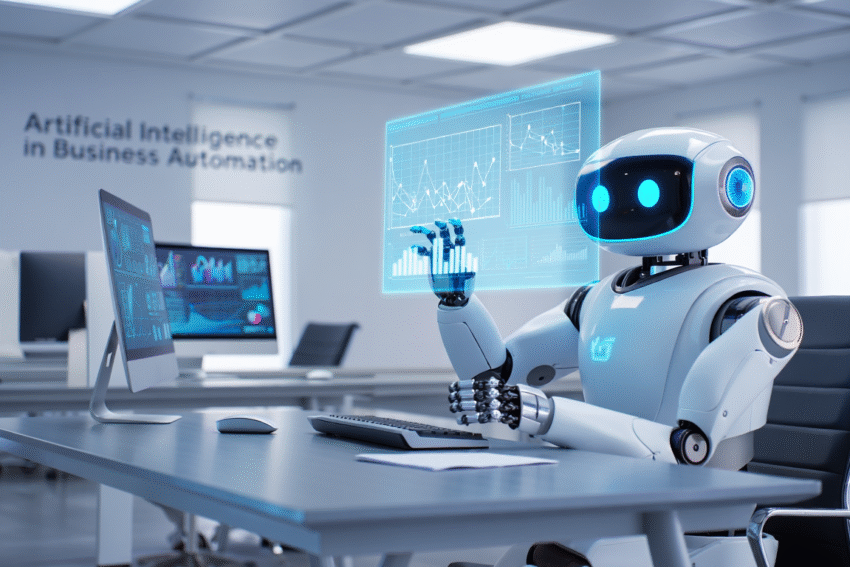
AI is increasingly available to small businesses and enables entrepreneurs to have a means of increasing productivity, bettering marketing efforts, improving administration and finding opportunities to grow. In addition to using AI as a substitute for employees, small business owners have found a way to use technology to enable their employees to engage in more creative and strategic activities.
With the continued use of AI, small business owners should adopt a more pragmatic approach to implementation of AI in their organizations. Rather than trying to implement AI into all areas at once, small business owners should identify problems and see how technology can help.
1. Identify Opportunities That Could Increase Sales
One of the key applications of AI includes supporting small businesses to explore opportunities which they would not be able to access otherwise due to lack of means and capabilities.
In this regard, AI can be used for writing website copy, coming up with advertisements and social media strategies, creating product descriptions and other marketing materials. The aim is to see what is lacking in a business and how AI could help close that gap.
2. Start With a Specific Business Problem
The company doesn’t have to use complex AI systems right away. The best way is to begin with some common problem which is difficult and takes much time.
This may be the problem of routine administration, of pricing, customer correspondence, marketing issues, research, scheduling, data management or anything else. Having determined the problem, it will become possible to check out what AI solution should be used.
Moreover, small steps make it easier to understand if the technology pays off.
3. Train Employees to Work With AI

Incorporation of AI technology is more effective when employees are able to grasp how the technology will help them in fulfilling their duties. Businesses should train their employees on the use of AI technology and allow the employees to discover the applications of AI for themselves.
Knowledge of the capabilities and limitations of AI technology will enable employees to handle the technology responsibly. Their experience with the business processes will give them an edge in discovering new applications of AI technology.
4. Use AI as a Productivity Multiplier

AI can be used by companies to do much more with fewer resources. Various industries would be able to utilize the technology differently according to their requirements.
Retail companies can make use of AI to study customer demand or to conduct personalized marketing. Restaurant industry can experiment with technology relating to scheduling and inventory management. Professional services can utilize AI for conducting routine research and documentation. Manufacturing industry can use the technology to conduct operation analysis and minimize waste.
It’s not about replacing people and automating tasks. It’s about making them capable of doing more.
5. Improve Back-Office Operations
Administrative work is likely to take up much of the time in a small business. AI can aid in making things simpler in terms of bookkeeping, accounting support, organizing information regarding taxes, sales leads, documents, and communication.
This can give the employees and the owners more time to focus on other work that will help in the growth of the business.
However, when it comes to money matters, it is always advisable for people who know about them to look at them.
6. Make Employee Onboarding More Efficient
Training newly hired staff members often entails great efforts for business organizations especially when it comes to explaining the processes, duties, systems, and company policies.
AI-assisted transcription and writing tools could aid in organizing materials for onboarding and creating training materials in a systematic way. The training materials will enable new employees to have something to refer to during their first days at work.
The organization must make sure that the information created by AI in regards to training is up-to-date according to company policies.
7. Select AI Tools Based on the Task
Not all AI platforms can solve all business needs. Platforms may differ in their performance when it comes to writing, researching, coding, analyzing data, creating images, automating processes, collaborating, or other tasks. Some entrepreneurs may also be interested in developing and modifying various digital tools on their own using AI coding platforms.
Hence, first of all, business owners should decide what they need to do and only then choose the most appropriate tool. It will help not to adopt some technologies just because they are fashionable.
The right tool is always the one that solves some business problems.
8. Prioritize Privacy and Data Security
AI can prove to be of great value once there is enough context, however, organizations need to exercise caution in regards to the data that they feed into external systems.
Financial data, personal data, private documents, passwords, contracts, and any other form of sensitive data must not be inputted into an AI system until the privacy, security, storage, and usage policies of the AI system have been fully understood.
There also needs to be clarity in terms of what can be submitted by employees and what cannot be submitted by employees on an AI system.
9. Take Advantage of AI Training and Coaching
Knowing how to implement AI technology might be just as crucial as choosing the right one. Entrepreneurs and workers will definitely gain from workshops, practice courses, coaching, industry literature, and hands-on experience.
Rather than learning through mere theory, employees are more likely to learn faster if they implement AI technologies for their workplace assignments.
Because of fast-changing technological advancements in the field of artificial intelligence, continuous education will be useful for companies.
10. Consider Investing in Premium AI Tools
Most AI platforms come with free versions, which makes it easier for small firms to use the technology. Nevertheless, there are cases where advanced options, greater limits, better integration, automation, and other special functionalities can only be accessed using a paid version.
A paid AI software becomes worth the price when it is capable of saving a significant amount of employee’s time, producing better-quality outcomes, helping in generating extra income or cutting down operating costs.
When choosing an AI software, one should consider its results rather than its price, because it doesn’t necessarily mean that the more expensive product brings more benefit.
AI Can Support Business Growth Without Replacing the Human Workforce
Another factor that small businesses must consider regarding the impact of artificial intelligence is its effect on the way in which their staff operates. In cases where tasks become faster or even automated, staff can then spend their time on more valuable tasks such as dealing with customers, solving problems, being creative, planning, etc.
This can be beneficial for expanding businesses, because it will give them an extra capacity as opposed to laying off people.
Conclusion
AI is becoming a tangible business tool for any enterprise regardless of size, from large enterprises to small startups. AI may turn out to be the most useful when implemented through a business as a solution to certain problems, as a means of increasing efficiency, improving marketing processes, and giving employees extra time to perform other necessary actions.
The best approach would be starting from defining the problem, choosing the proper tool, training the employees, ensuring the security of the data, and analyzing the results. If properly applied, AI can prove to be one more tool for the development of a small business.
Frequently Asked Questions
Small businesses can use AI for marketing, content creation, customer communications, research, bookkeeping support, lead generation, employee onboarding, scheduling, inventory management, and other repetitive or data-intensive tasks.
Yes. AI can help employees complete routine tasks more efficiently, allowing them to focus on customer service, strategy, creativity, problem-solving, and other responsibilities that require human judgment. Increased productivity can also give growing businesses greater capacity to hire additional workers.
They can be, particularly when advanced features save significant time, improve productivity, support revenue generation, or reduce operational expenses. Businesses should compare the cost of a paid service with the measurable value it provides before committing to it.