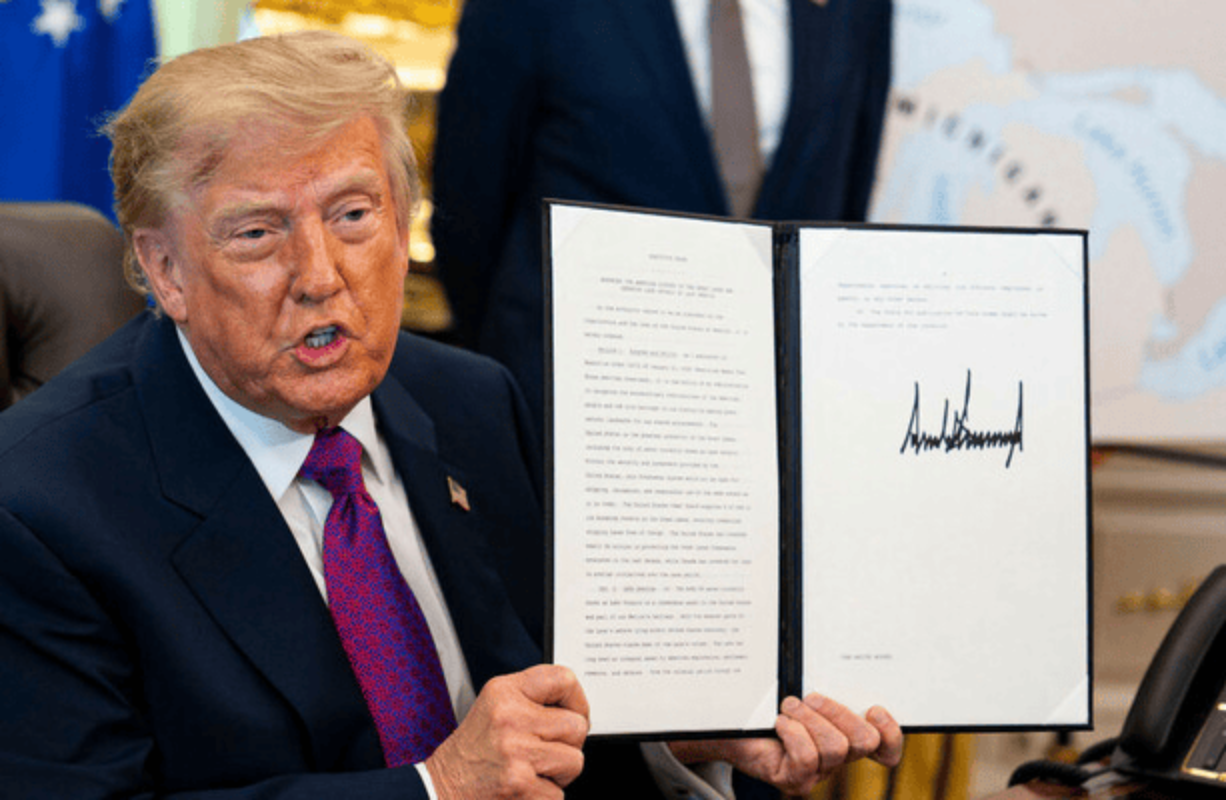
A recent executive order by President Donald Trump directing federal agencies to refer to Lake Ontario as “Lake America” has sparked renewed debate about presidential authority, geographic naming, and the broader relationship between the United States and Canada.
The announcement came during a period of heightened trade tensions between the two neighboring countries. While the executive order can influence how the U.S. federal government identifies the lake in official records and communications, changing the name of an internationally shared geographic feature is considerably more complicated.
What Does the Executive Order Change?
The executive order directs the U.S. Department of the Interior and other federal agencies to take appropriate steps to rename Lake Ontario as “Lake America” in relevant federal records.
One significant effect could involve the Geographic Names Information System, a federal database containing information about physical and cultural geographic features. Federal maps, documents, contracts, and official communications may begin reflecting the new designation.
However, an executive order does not automatically require other countries, private organizations, international mapping services, media outlets, or members of the public to adopt the same terminology.
Lake Ontario is shared by the United States and Canada, making the issue more complex than changing the name of a geographic feature located entirely within U.S. territory.
Why the Lake Ontario Name Is Significant
The name “Ontario” has deep historical and Indigenous connections. The term is commonly associated with the Wendat language, with interpretations relating to a beautiful or great lake.
The lake’s name has been used for centuries and predates both modern Canada and the United States. As a result, changing its name has generated discussion not only about politics but also about history, cultural heritage, and the preservation of established geographic identities.
Canadian officials have strongly rejected the proposed name change, maintaining that the body of water will continue to be known as Lake Ontario.
The Role of U.S.-Canada Relations

The renaming effort emerged during a period of increasing tensions between the United States and Canada, particularly involving trade negotiations and tariffs.
The disagreement has also drawn attention to the political symbolism associated with geographic names. Place names can represent history, national identity, and cultural heritage, meaning changes often generate reactions that extend beyond maps and government documents.
Because Lake Ontario forms part of the boundary between the United States and Canada, both countries have a longstanding connection to the lake. Any attempt to establish a new name is therefore likely to face practical and diplomatic challenges.
Can a President Rename an International Body of Water?
A U.S. president can direct federal agencies regarding the terminology they use in official documents and federal databases. This authority can affect how government departments, agencies, and certain federally produced maps refer to geographic locations.
However, presidential authority does not extend to forcing foreign governments or international organizations to use a particular name.
The experience surrounding the Gulf of Mexico demonstrates how geographic name changes can produce different results across platforms and institutions. While the U.S. government adopted “Gulf of America” for certain official purposes, the traditional name continues to be used by numerous governments, media organizations, mapmakers, and members of the public.
Digital mapping platforms may also apply different naming conventions depending on a user’s location and the policies of the service provider.
Geographic Names and Public Acceptance
Official government action is only one factor in determining whether a new geographic name becomes widely accepted.
Public usage, historical traditions, international recognition, educational materials, mapping companies, media organizations, and foreign governments all play a role in how places are identified over time.
Some name changes eventually become broadly accepted, while others remain limited to specific governments or institutions. The adoption of a new name often depends on whether there is widespread political, cultural, and public support.
In the case of Lake Ontario, the longstanding use of its existing name and the involvement of two countries could make universal adoption of “Lake America” particularly challenging.
A Continuing Debate Over Names and National Identity
The Lake Ontario controversy is part of a broader discussion about how governments use geographic names to communicate national identity and political priorities. Similar debates are also emerging in Canada, including Ottawa’s consideration of renaming Trump Avenue amid growing U.S.-Canada tensions.
Supporters of renaming initiatives may view them as an opportunity to emphasize national history or identity. Critics may argue that changing long-established names can overlook historical, Indigenous, or international connections associated with those places.
The debate also highlights an important distinction between changing an official government designation and changing how the world collectively identifies a geographic location.
Conclusion
The effort to rename Lake Ontario as “Lake America” demonstrates that changing the name of a major geographic feature involves far more than an executive order. While the U.S. government can direct federal agencies to adopt a particular designation, it cannot require Canada, international institutions, private companies, or the public to follow the same terminology.
With centuries of historical use behind the name Lake Ontario and strong opposition from Canada, the long-term acceptance of the new designation remains uncertain. The situation continues to illustrate how geography, politics, history, and national identity can intersect when governments attempt to redefine familiar places.
FAQs
A president can direct U.S. federal agencies to use a new name in official records, maps, and communications. However, that authority does not require Canada, international organizations, private companies, or the public to adopt the new name.
The proposal is controversial because Lake Ontario is shared by the United States and Canada and has a name with centuries of historical and Indigenous connections. Canadian officials have also rejected the proposed change.